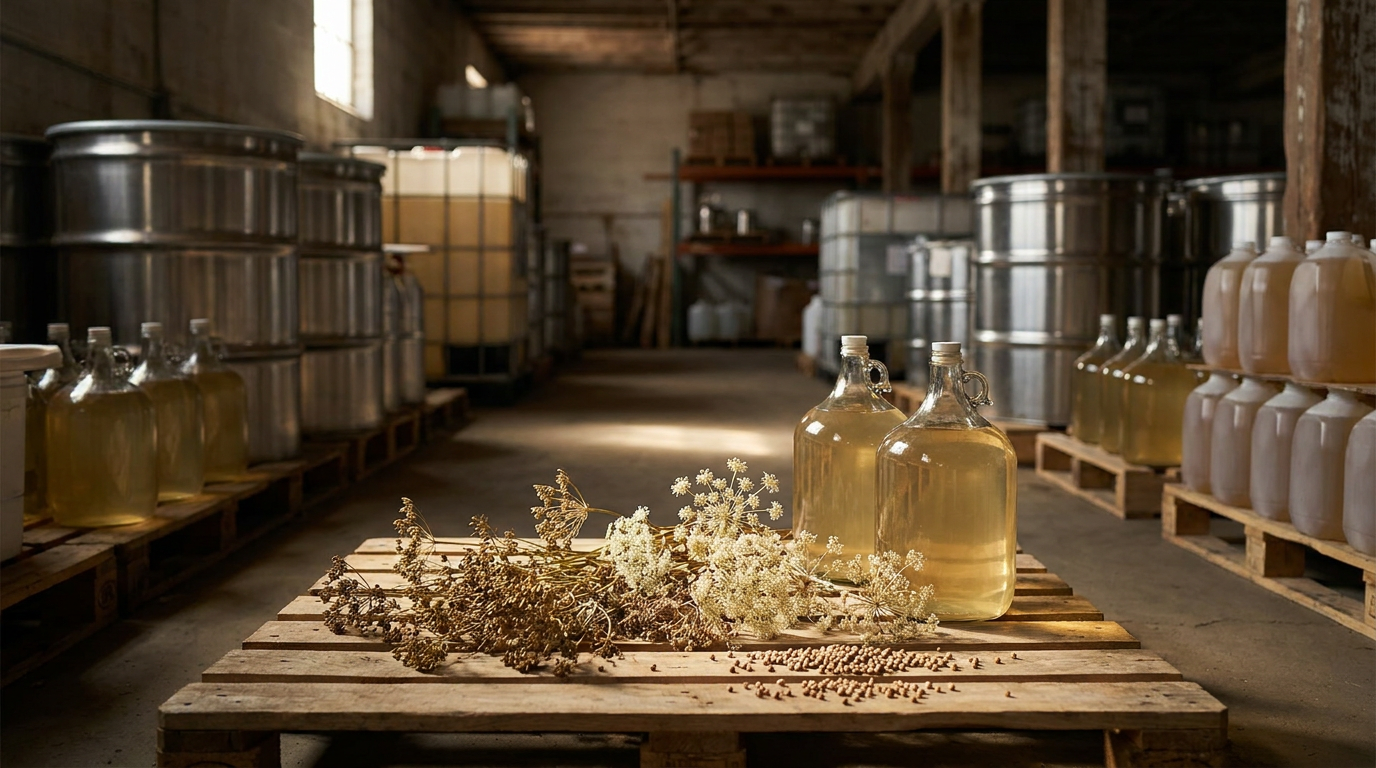
Coriander essential oil moves at wholesale volume into perfumery, candle making, soap and skin care formulation, and spa body-oil work, all of them drawn to the same warm, woody, softly spicy character. Buying at scale means understanding how this oil is graded, what a genuine Certificate of Analysis looks like, and which of the ten real sizes fits your production stage.
Compare pricing across every bulk tier before you commit to a drum.
Coriander essential oil sold at wholesale volume is steam-distilled from the ripe, crushed seed of Coriandrum sativum, not the fresh leaf that gives cilantro its sharp green profile. The seed oil trades that leaf-forward pungency for a rounder, warmer character built on naturally occurring linalool, the same aromatic compound that gives lavender its softness. Buyers new to the category can get the full production picture in how the oil moves from ripe seed to steam still, which lays out why seed selection and still time matter as much as origin.
For buyers building a first specification sheet, a complete guide to what coriander seed essential oil actually is is a useful baseline before comparing supplier quotes. Origin matters too: cultivation and distillation both run heaviest out of India and Russia, and the agronomic and harvest differences between those regions are covered in where coriander grows and how the harvest differs by region.
Because linalool concentration drives both aroma and blending performance, formulators frequently ask suppliers to speak to it directly rather than relying on the ambiguous term high grade. A closer look at the linalool molecule behind the smoothness explains why this single compound is the throughline between the oil's cosmetic and fragrance uses.
| Sold as | What it actually is | How to recognize it |
|---|---|---|
| Coriander Seed Essential Oil | Steam-distilled from the ripe seed only, with no leaf material in the still | Aroma is warm and softly spicy with a citrus-peel whisper, never sharp or green |
| Coriander Leaf Oil (Cilantro Oil) | Distilled from the fresh leaf and stem, a different aromatic profile entirely | A sharp, green, almost soapy top note, sold under a separate name when suppliers are transparent about it |
| Coriander Seed CO2 Extract | A solvent-free extraction method that concentrates the seed's aromatic and waxy components differently than steam distillation | A heavier, less volatile character and a different price point than the steam-distilled oil |
| Coriander Fragrance Oil | A synthetic reconstruction built to mimic the aroma, not derived from the plant | Often labeled nature identical, or carries no botanical sourcing claim at all |
Buyers who source across multiple formats should read how the seed oil compares with the CO2 extract on aroma and cost and the difference between a genuine essential oil and a fragrance oil before a quote comes in unusually cheap.
The recurring sourcing trap in this category is a supplier who quotes a coriander seed oil price that only makes sense for leaf oil or a cut fragrance oil. Origin-by-origin sourcing notes covering Australia and beyond and a buyer's checklist for spotting pure seed oil before paying both walk through the same lesson: confirm plant part and extraction method in writing before the drum ships, not after it arrives smelling wrong.
The wholesale buyers of coriander essential oil cluster around a handful of trades that value its warm, woody, softly spicy middle note rather than any sharp edge. Independent perfumers and cologne houses use it as a blending bridge between citrus top notes and heavier woods, candle studios fold it into autumn and spice-forward pours, and soap and skin care formulators reach for it in low concentration to round out floral and citrus accords. A rundown of the top picks by use across perfume, skin, and home gives a sense of how differently each of these buyers specs the same oil.
Order sizes tend to track the buyer's production scale rather than the industry as a whole: a home-studio candle maker or soap crafter usually starts in the 5 lbs to 25 lbs range, while a contract perfumer or private-label skin care brand moves into 100 lbs and 400 lbs drums once a formula is locked. A guide to bulk sizes and pricing for wholesale coriander seed oil breaks down that progression in more detail.
Before placing a first bulk order, confirm the following on paper.
Reading the GC-MS report itself is a skill worth building before a first large order goes out. A buyer's checklist for reading a coriander oil GC-MS report walks through which peaks and ratios actually matter, and this site's own batch documentation is published at the current Certificate of Analysis for reference.
Coriander essential oil is sold here across ten sizes, from a 0.5 oz sampler through a 400 lbs drum, so the same seed-oil standard scales from a first test batch to a full production run. A guide to which bottle to order first is written for retail buyers, but the same logic of testing small before committing applies to a wholesale first order.
Per-pound pricing improves meaningfully at the 100 lbs and 400 lbs tiers, and the underlying cost drivers, crop yield, distillation time, and regional harvest conditions, are explained in a price guide covering what drives the cost per ounce. Full pricing across every size sits on the wholesale pricing page.
Start with a 4 oz or 8 oz bottle from the shop and run it through an actual batch before committing to a drum.
Request the batch Certificate of Analysis and confirm plant part, extraction method, and aroma against your sample.
Order at the 25 lbs, 100 lbs, or 400 lbs tier through the wholesale page, specifying packaging and lead time in writing.
Once a formula is set, schedule a standing reorder against the same lot profile so aroma stays consistent across production runs.
The application-specific guides below cover the buyer categories that make up most of the wholesale demand for this particular oil.
Independent perfumers and cologne houses buy coriander seed oil as a citrus-to-woods bridge note, prized for its warm, softly spicy character rather than any sharp edge.
Read the sourcing guide →Candle studios use coriander seed oil to add a soft spice note to autumn and fall-forward pours without tipping into a predictable holiday-spice cliche.
Read the sourcing guide →Home fragrance brands and reed diffuser makers use coriander seed oil to add a warm spice undertone to citrus and floral diffuser blends.
Read the sourcing guide →Soap makers buy coriander seed oil to add a warm spice note to citrus and floral cold-process bars, working within careful dilution limits for skin-safe use.
Read the sourcing guide →Skin care brands and private-label formulators use coriander seed oil in careful dilution for its rounded, linalool-rich aroma in lotion and blend work.
Read the sourcing guide →Hair care brands use coriander seed oil in low dilution to add a warm spice note to scalp and shine-focused blend formulas.
Read the sourcing guide →Spa and body-care brands use coriander seed oil in blended body oils for its warm, rounded aroma, choosing it over sharper notes when a session room calls for something softer.
Read the sourcing guide →Reach out with your target size and use case and we will confirm current lot availability.